Scientists from the CEET Nanotechnology Centre organised an experimental workshop in their laboratories, focusing on the frictional properties of automotive brake discs and researching the particulate matter produced during their operation. Experts from the Faculty of Materials Science and Technology at VSB-TUO and the partner institution, Sakarya University in Turkey, also joined the research. The aim of this international collaboration is to develop and test new materials that will help the automotive industry reduce brake particulate emissions and respond to the strict limits of the upcoming Euro 7 standard.
The workshop, held as part of the research activities of the MATUR project (Materials and Technologies for Sustainable Development), addresses a highly topical issue in modern transport. Whilst exhaust emissions have been successfully reduced over the long term, wear debris from brakes and tyres represents an increasingly significant problem for urban air quality.
"Braking is not just about whether a car stops safely. This process also generates particles that are released directly into the air in the streets, where people can inhale them," explains Bohumír Strnadel, the principal investigator of the MATUR project.
During operation, the braking system releases particles of various sizes and compositions. These can contain metals, their compounds, and organic substances. Whilst larger particles are visible to the naked eye, very small particles can remain airborne and pose a health risk. The quantity and character of the generated particles are influenced by a number of factors, such as vehicle speed, clamping force, and braking intensity.
The collaboration with Turkey’s Sakarya University brings not only new perspectives but, above all, entirely new types of materials for testing. Its researchers have long been engaged in developing new materials and surface treatments for brake discs. One of their main objectives is to increase wear resistance while simultaneously limiting the amount of particulate matter generated during braking.
"The automotive industry must prepare for increasingly stringent requirements regarding particulate emissions from braking systems. Using laser deposition techniques, we are therefore attempting to create special composite layers on the surface of brake discs. We coat them with materials such as nickel, titanium, titanium carbide, aluminium oxide, or stainless steel with the addition of ceramic particles. The laboratory results so far have been very good," states Hakum Akbulut from Sakarya University.
The Turkish scientists brought a disc treated in this exact way to the workshop so they could test it together with their colleagues on a dynamometer. This is a sample provided to them through their collaboration with Ford Otomotiv Sanayi A.Ş.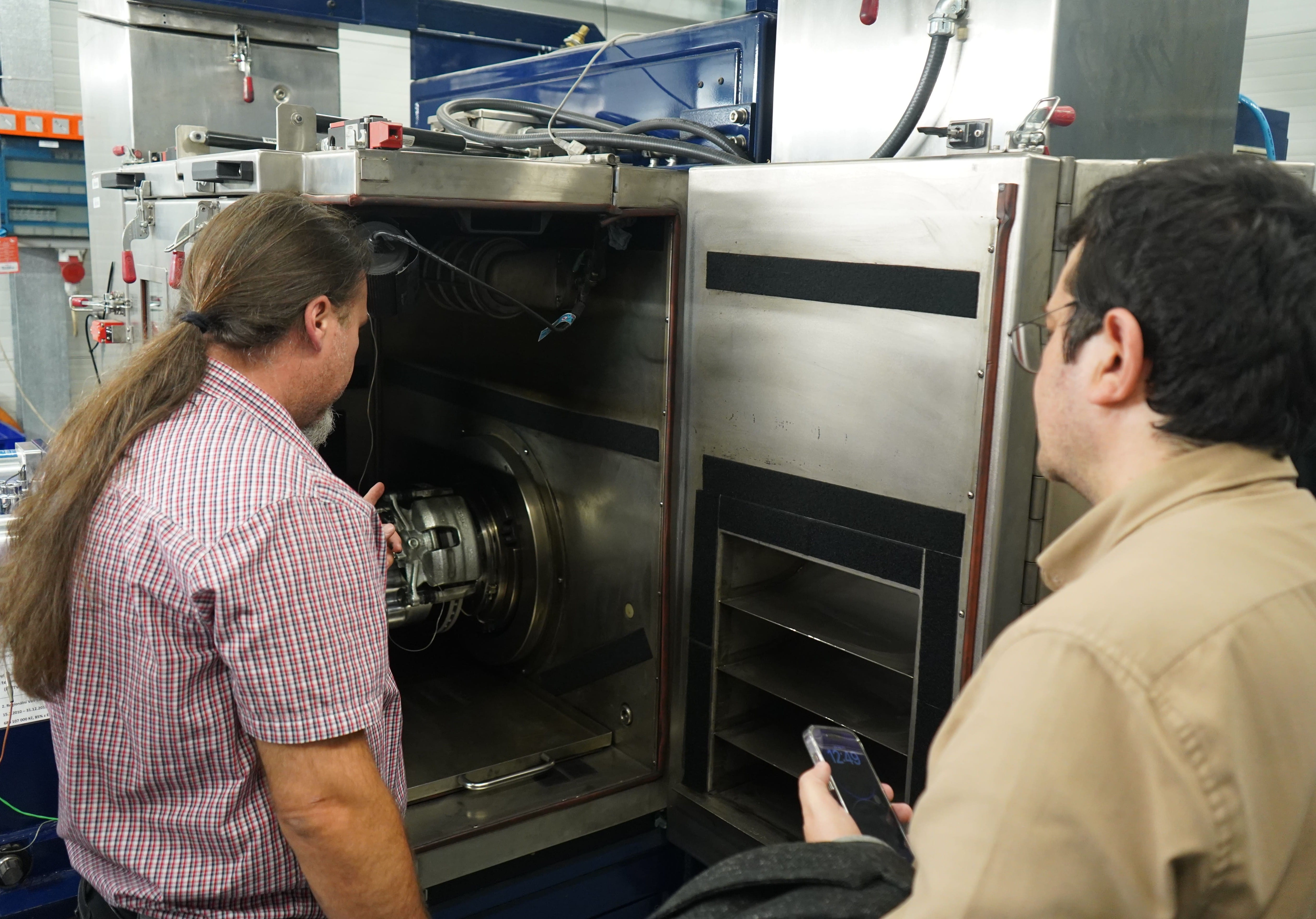 Measuring and testing braking processes is exceptionally demanding, both technologically and analytically. During braking on dynamometers, high speeds and temperatures are generated, and the emitted particles vary in size.
"Determining parameters such as speed, clamping force, or the chemical and structural composition of brake discs and brake pads is a highly complex issue. That is precisely why collaborating with other research institutes and comparing results from different laboratories is important to us," adds Bohumír Strnadel.
As part of the research, the Faculty of Materials Science and Technology investigates frictional properties and is in charge of dust sampling, whilst the Nanotechnology Centre performs advanced material characterisation of this wear debris.
"The laboratories of the Nanotechnology Centre have been dedicated to evaluating brake surfaces (the so-called friction layer) and brake wear for several decades," explains Gabriela Kratošová from CNT. "Thanks to the first-class instrumental equipment at our facility, we are able to evaluate surfaces and particles using electron microscopy, as well as investigate their chemical and structural composition using spectroscopic and diffraction methods."
The joint research by the Nanotechnology Centre at CEET, the Faculty of Materials Science and Technology at VSB-TUO, and Sakarya University is delivering concrete solutions for practical application and upcoming legislative changes. The insights gained through the MATUR project and testing on cutting-edge dynamometers thus hold tremendous potential for real-world use within the automotive industry.