The trees planted as part of the project are growing, the monitoring equipment continues to collect data, and experts are evaluating how the concentrations of pollutants that most strongly affect air quality are changing in the area.

In recent years, an important role has also been played by the shutdown of operations at Liberty Ostrava a.s., which had been among the largest sources of air pollution in the locality. In September 2023, the coke plant ceased operation, and by the end of the same year the company’s activities were interrupted more broadly. It was therefore reasonable to expect that this change would also be reflected in improved air quality.
According to an assessment by the Czech Hydrometeorological Institute, air quality improved by approximately 30% year-on-year. As a result, a locality that had long ranked among the most polluted areas in the Czech Republic moved closer to values typical of the wider Ostrava area. More detailed information is available in the Institute’s yearbook, “Air Pollution in the Czech Republic in 2024.”
In the areas monitored by the CLAIRO project, the improvement was reflected mainly in lower concentrations of PM10 suspended particulate matter and nitrogen oxides. Suspended particles, often simply referred to as “dust,” have long been one of the most significant pollutants in the Ostrava region. They may originate from industry, transport, local heating, and transboundary air pollution transport.
The situation with ozone is more complex. Ozone concentrations are strongly dependent on sunlight, temperature, and chemical reactions in the atmosphere. Although vegetation helps stabilise the local environment, average ozone concentrations have so far tended to stagnate. Even this result, however, needs to be interpreted in connection with the decrease in nitrogen oxides, since the formation and breakdown of ground-level ozone are chemically interlinked processes.
Development of PM10 Concentrations in the Project Area
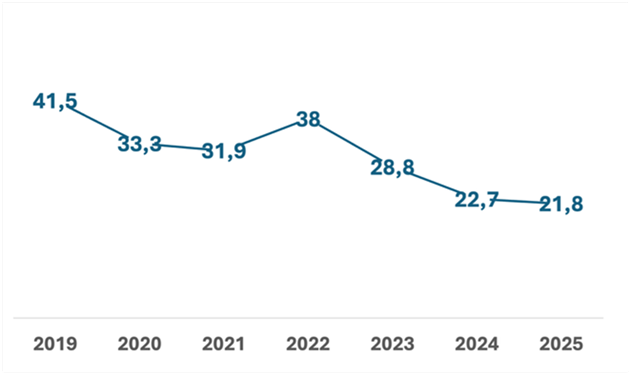
According to the methodology developed by Dr Zapletal from Silesian University, the original objective of the planting was to reduce PM10 concentrations by several micrograms per cubic metre in the annual average. The measured decrease, however, has been more substantial. From a scientific point of view, it is important to state that this cannot be attributed to the trees alone. Several factors have contributed to the improvement: reduced industrial emissions, changes in traffic, weather conditions, the broader European trend of improving air quality, and the gradual growth of the planted vegetation.
This is precisely why long-term monitoring is so important. It makes it possible to distinguish short-term fluctuations from real trends and to better determine the extent to which urban greenery can contribute to improved air quality. As trees mature, their leaf area increases, allowing them to capture dust particles more effectively, influence the microclimate, and help stabilise the local environment.
The development after 2023 is particularly encouraging. PM10 concentrations fell to 28.8 µg/m³, and in 2024 and 2025 the decline continued, reaching values of around 22 µg/m³. A significant decrease was also recorded for nitrogen oxides: between 2022 and 2025, their concentration fell by more than 15 µg/m³.
The project results are therefore promising. They show that a combination of reducing major pollution sources, long-term monitoring, and well-designed work with urban greenery can bring measurable improvements. At the same time, expert evaluation must continue in order to describe more precisely how much of the improvement can be attributed to the planting itself.
Colleagues from CEET are also working on further refining the methodology, interpreting the results, and identifying ways to strengthen the positive effects of greenery. Monitoring of the ambient air pollution situation in Bartovice will continue at least until the end of the project sustainability period, that is, until 2028. This will make it possible to better document how air quality develops over a longer time horizon and what role trees can play in this process as a natural element of the urban environment.