.jpg?attachmentId=5514&image=true)
It was exactly these possibilities that scientists from the Centre for Energy and Environmental Technologies of VSB-TUO and representatives of the BorsodChem MCHZ company, which is a partner of the DMS ITI project – Waste as an Alternative Energy Source, focused on during a professional meeting. Representatives of the industrial sphere and scientists from the Institute of Environmental Technology (IET) jointly discussed the latest research results, which open the door to a more sustainable and greener chemical industry.
The visit took place at the Institute of Environmental Technology of CEET and included a tour of selected laboratories as well as a discussion on the current research results. The main topic was the catalytic hydrogenation of bicarbonates to formates. Simply put, it is a process in which bicarbonates, as a captured form of CO2, are converted into chemically usable products in the presence of a catalyst and hydrogen. Formates can serve as a raw material or intermediate for further chemical processes and represent one of the ways to reintegrate carbon from captured CO2 back into the industrial cycle.
The research is part of the research direction VP4 "Capture, separation, and catalytic transformation of CO2", which focuses on technologies enabling not only the separation of captured carbon dioxide but also its further meaningful utilisation. The aim is not only to reduce emissions but to look for technically and economically realistic ways to create new resources for the chemical and energy industries from waste streams.
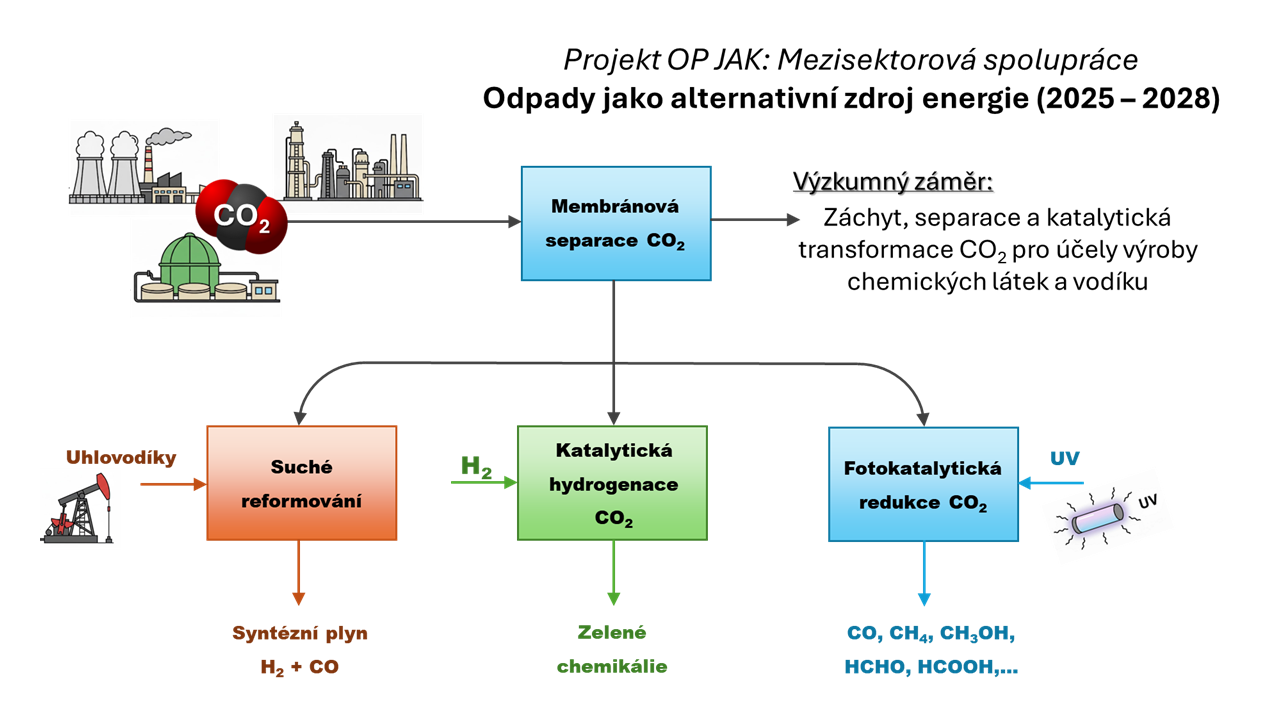
The meeting with representatives of the BorsodChem MCHZ company made it possible to connect the current CEET research with the specific needs of the chemical industry. The discussion focused mainly on the further development of laboratory results towards practical utilisation and on the technical requirements that such a solution would have to meet.
The development of these advanced technologies and the cooperation with BorsodChem MCHZ is taking place within the framework of the DMS ITI project "Waste as an alternative energy source", reg. number CZ.02.01.01/00/23_021/0008590, which is supported by the ESF within the Jan Amos Komenský Operational Programme, Call No. 02_23_021 Intersectoral cooperation for ITI.
